
Social Media Crisis Response Plan: A Practical Guide for Teams
Build a social media crisis response plan with clear triage levels, pause rules, owners, evidence, corrections, escalation paths, and a useful post-incident review.

A social media crisis response plan is a written playbook for deciding what happens when a post, reply, campaign, account, or scheduled queue creates material risk. It identifies who leads, how the team verifies the event, which content pauses, who can speak publicly, what evidence is preserved, when specialists join, and how normal publishing resumes.
Free tool
Find your best posting time
Get a personalized weekly plan in about 60 seconds. No signup needed to see your schedule.
Try the free plannerNot every negative comment is a crisis. A plan should help a team distinguish routine moderation from a factual error, a fast-moving reputation issue, a safety concern, or a suspected account compromise. That distinction prevents both underreaction and the equally costly habit of treating every uncomfortable reply as an emergency.
The three named examples below are realistic composite scenarios created for instruction. They are not customer stories, testimonials, performance claims, or accounts of actual PostTempo users. The response windows are planning assumptions, not industry benchmarks or promises.
Define an Incident Before One Happens
Write a short activation definition that a new teammate can apply. One workable definition is: activate the response plan when social content or account activity may cause continuing harm, requires authority beyond the routine publisher, or needs coordinated action across content, security, legal, client, or leadership roles. This is an editorial recommendation. Your organization may need a narrower definition based on its obligations.
Create examples beside the definition. A typo with no material effect may stay in the normal correction path. A wrong store-closing time that could send customers to a closed location deserves prompt correction and documentation. A false health claim, leaked personal information, threat, or unauthorized administrator requires immediate escalation to the relevant qualified owner.
Separate a signal from a verified fact. A screenshot sent by a teammate is a signal. The live post URL, account activity record, publishing log, current queue, and platform notification help establish what happened. Do not repeat an alarming claim publicly just because it appears in a fast-moving comment thread. Record what is known, unknown, assumed, and being checked.
Define closure too. An incident is not finished merely because a post was deleted. Closure may require confirming that the harmful content is no longer queued, access is secured, affected people are informed, a corrected statement is approved, monitoring has an owner, and follow-up actions have due dates.
References and related guides
Assign Response Roles and Backups
Choose an incident lead who coordinates decisions but does not have to perform every task. Add an account operator who can inspect and pause publishing, an evidence recorder who maintains the timeline, a communications owner who drafts internal and public updates, and the specialist owners who join for security, legal, compliance, safety, employment, or client questions.
One person may hold several roles in a small organization. A solo creator can be incident lead and account operator while calling a manager, sponsor contact, platform support channel, or qualified professional when needed. The important point is to switch deliberately from routine publishing into response mode and to know which decisions cannot be made alone.
Every critical role needs a backup and a reachable contact method. CISA's plan basics recommends clarifying roles and maintaining a list of key people who may be needed during a crisis. Record the primary contact, backup, authority, and the trigger for contacting them. Keep an alternate channel available in case the normal social account or workplace chat is unavailable or untrusted.
Avoid shared passwords as a continuity plan. Use individual access and current platform security controls. Meta's account-security guidance points users to login alerts and two-factor authentication. TikTok Business Center guidance recommends limiting administrator access, reviewing access, removing inactive users, and granting only the access needed. Confirm the controls available in each current account because menus and requirements change.
- Incident lead: owns coordination, severity, decisions, and closure.
- Account operator: verifies live state, pauses queues, and follows approved account actions.
- Recorder: preserves evidence, timestamps, approvals, and unresolved questions.
- Communications owner: prepares internal, client, and public messages for approval.
- Specialist owner: decides matters that require security, legal, compliance, safety, or other expertise.
References and related guides
Use a Five-Level Triage System
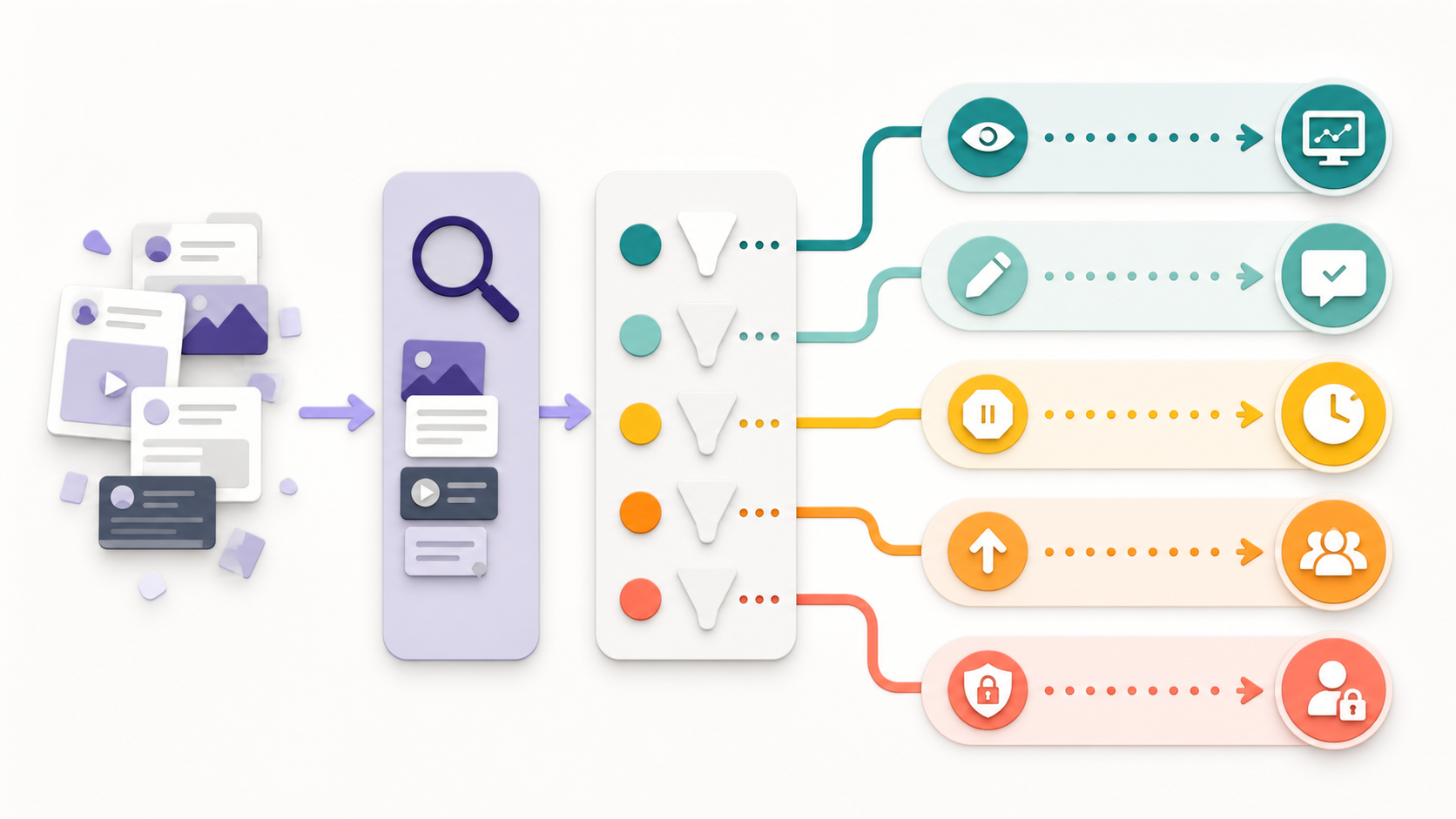
Use a small severity ladder so teammates can make a consistent first classification. The five levels below are PostTempo Editorial's suggested operating model, not a platform standard. Tailor the labels and triggers to your accounts, contracts, locations, and regulated obligations.
Level one is routine: a normal complaint, isolated spam, or simple typo with no material consequence. Follow moderation and correction rules. Level two is material content error: a wrong fact, broken offer, missing disclosure, incorrect account, or asset that can mislead an audience. Preserve the original and route the correction quickly.
Level three is growing reputation or campaign risk: unusual attention, coordinated complaints, creator or client conflict, or a message spreading beyond the original audience. Pause adjacent campaign content while the incident lead verifies context. Level four involves safety, rights, regulated claims, employment, harassment, personal information, or credible legal exposure. Bring in the qualified owner immediately and avoid improvising public conclusions.
Level five is suspected account compromise or coordinated harmful activity. Stop routine publishing on affected accounts, preserve evidence, use official recovery procedures, review access, and involve security. Do not let a marketing checklist substitute for an incident-response professional when systems or identities may be compromised.
Severity can change. A level-two correction may become level three if an outdated screenshot spreads after the edit. A loud complaint may return to routine handling after verification shows no broader harm. Record the reason whenever the level changes so later reviewers can understand the decision.
The First Fifteen Minutes: Verify, Preserve, and Contain
The fifteen-minute window is a worked planning example, not a universal deadline. Assume a small team notices a potentially harmful post at 10:00. By 10:03, the on-duty person records the live URL, account, discovery source, current time, visible content, and reporter. By 10:07, the account operator checks whether the post is authentic, scheduled elsewhere, or part of a larger queue. By 10:10, the incident lead assigns a provisional severity and owner. By 10:15, the team has either documented routine handling or activated a pause and escalation path.
Calculation: 3 minutes for the initial record, plus 4 minutes for live-state verification, plus 3 minutes for triage, plus 5 minutes for containment and notification equals 15 minutes. This example assumes the required people and account access are available. A solo creator, global organization, regulated team, or compromised account may need a different timeline.
Preserve what existed before editing or removing it, subject to professional instructions and applicable law. Useful records can include the live URL, full-page screenshot, exact copy, media file, publication time, destination link, account, audience settings, visible metrics at the observation time, approval record, publishing log, and relevant platform notice. Note who collected each item and when.
Containment means reducing additional harm without destroying the team's ability to understand the event. It may include pausing related scheduled posts, removing a draft from approval, limiting access, or placing an account in security recovery. The appropriate action depends on the incident. When evidence preservation, reporting duties, or personal information are involved, follow qualified guidance.
References and related guides
Decide What to Pause and What Can Continue
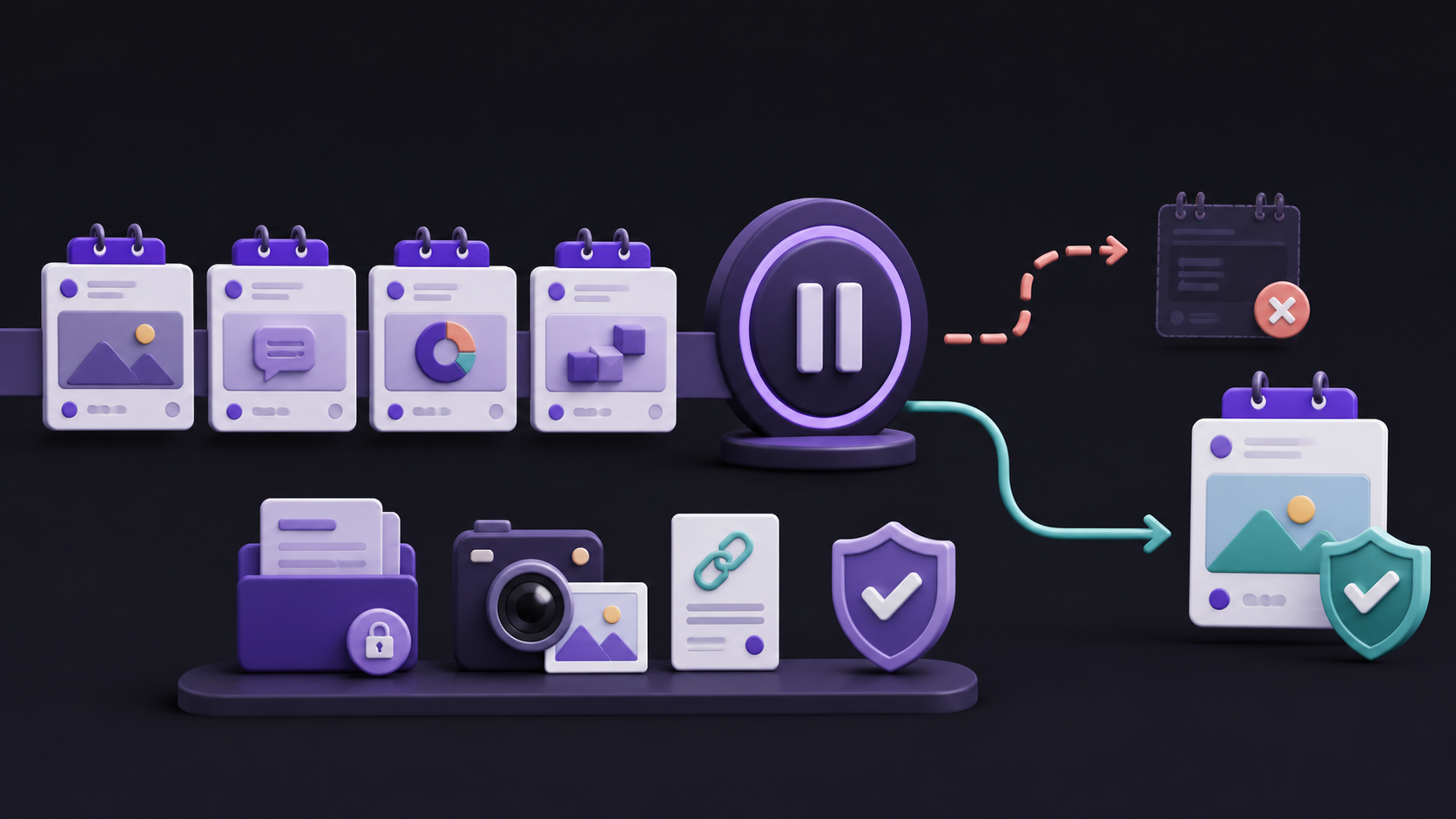
A blanket pause is sometimes necessary, but it should be a conscious scope decision. Start with the affected account, campaign, message, scheduled variants, paid promotion, and automated follow-ups. Then check adjacent content that could appear insensitive, contradictory, or confusing while the incident is active.
Ask five questions. Could the next post repeat the error? Could it direct people to the same broken or unsafe destination? Could its tone look inappropriate beside the incident? Does it depend on facts now under review? Would continuing make containment or public communication harder? A yes answer supports pausing that item until the incident lead reviews it.
Some content may continue. An unaffected account serving a different audience may have no relationship to a minor correction. Essential public-service information may need to stay live. Record the reasoning rather than relying on an unwritten assumption that everything stops or everything continues.
PostTempo product observation: the application includes calendar, queue, approval, media-validation, publishing-status, failure, and retry states. Those controls informed this pause model because an operator needs to distinguish a draft, approved item, scheduled job, live publication, and failed attempt. Product state alone does not decide crisis severity or satisfy professional obligations.
References and related guides
Choose Between Monitoring, Replying, Correcting, and Removing
Monitoring is appropriate when the team has verified a low-risk issue, assigned an owner, and defined a time or condition for the next review. Monitoring does not mean ignoring. Record what channels are watched, how frequently, which signals change severity, and who receives the update.
Reply when a direct, accurate answer can help the affected audience and the right owner has approved it. Avoid arguing, speculating, blaming the reporter, or promising an outcome the team cannot deliver. A short holding statement can acknowledge awareness and explain where verified updates will appear, but legal, safety, privacy, or security circumstances may require specialist review before any public response.
Correct when a material fact, destination, disclosure, or asset is wrong. Preserve the original record, prepare the corrected version, verify every affected placement, and obtain new approval. For United States endorsements, FTC staff guidance says material connections should be obvious and disclosures should be hard to miss, placed with the endorsement, and stated simply. If a sponsored post lacks an adequate disclosure, adding a vague note in a distant profile is not the workflow described by that guidance.
Remove when leaving the content live would continue harm, violate a policy or right, expose sensitive information, or obstruct recovery. Do not use deletion as the only record. Capture the relevant evidence first when safe and permitted, record who authorized removal, and check queued variants and cross-posts. Platform behavior varies, so confirm current edit, deletion, and recovery options in the affected service.
References and related guides
Scenario One: Amina Patel Corrects a Sponsored Post
Amina Patel is an illustrative home-organization creator. At 9:20, she learns that a sponsored caption published at 9:00 names an offer end date that changed after approval. The product itself is not unsafe, but the date could mislead people. Amina records the live post, caption, approval message, sponsor brief, and current destination page. She classifies the event as a level-two material content error.
Amina pauses the scheduled reminder and asks the sponsor contact to verify the current date in writing. She does not guess from a comment. The corrected caption keeps the sponsorship disclosure visible beside the endorsement, replaces the date, and returns to approval. She also checks the video overlay and destination page because correcting only the caption would leave conflicting information.
Amina publishes the approved correction and records when each placement changed. She monitors replies for people referencing the old date. Her closing note identifies the cause as an offer update that arrived outside the current version record, not as individual carelessness. The follow-up action requires future offer changes to reopen approval automatically.
Assumption: the sponsor responds promptly and the platform allows the needed correction. Limitation: Amina's contract, audience location, advertising law, and platform controls may require a different response. She should obtain qualified advice for obligations that the operational plan cannot resolve.
Scenario Two: Harborlight Studio Handles a Client Mix-Up
Harborlight Studio is an illustrative agency managing separate calendars for two independent hospitality clients. An account manager discovers that an approved image for Client A was scheduled with Client B's caption on Client B's account. The post has been live for six minutes. The agency preserves the URL, screenshot, media identifiers, approval records, and publishing log, then pauses both clients' related queues until it can establish scope.
The incident lead classifies the event as level three because it crosses client boundaries and could involve contractual or media-rights questions. The account operator removes the mismatched post after recording authorization. The client lead contacts each named client representative through the agreed incident channel. The team avoids a public explanation until the responsible client contacts and, if needed, counsel approve the wording.
Verification shows the mix-up occurred during a manual asset replacement after approval. Harborlight creates the correct post but does not publish immediately. It sends the exact caption, image, account, and time through fresh client approval. The second client's content remains paused until the lead confirms that no other draft contains the wrong asset.
The review adds two controls: material asset replacement invalidates approval, and the publisher must verify the destination account beside the final preview. These are process improvements from the scenario, not proof that a particular tool eliminates cross-client mistakes.
References and related guides
Scenario Three: Redwood Foods Protects a Compromised Account
Redwood Foods is an illustrative regional food brand. Its community manager receives an unfamiliar login alert and sees an unauthorized post that promotes a fraudulent giveaway. The team treats this as a level-five suspected compromise rather than a normal content mistake. It moves coordination to the approved alternate channel and contacts the security owner immediately.
The account operator follows the platform's official recovery flow, while the recorder captures the alert, post URL, time, affected account, known administrators, and actions taken. The team pauses the affected queue and related campaign messages. It does not send credentials through chat, improvise a public accusation, or assume that deleting one post ends the event.
After access is restored, the security owner reviews administrators, connected tools, recent changes, authentication methods, and any broader systems in scope. Marketing drafts a customer-facing notice only from verified facts and routes it through the appropriate security, communications, and legal owners. The response lead defines how long monitoring continues and what would reopen the incident.
Product observation: publishing logs and visible queue states can help reconstruct content activity, but they are not a full security investigation. Limitations: recovery options differ by platform, evidence needs may differ by jurisdiction, and a real compromise can extend beyond social accounts. Redwood should follow its security plan and qualified professional advice.
References and related guides
Build a One-Page Response Runbook
Turn the full plan into a one-page runbook that an on-duty teammate can use under pressure. Put the activation definition, severity ladder, primary and backup contacts, evidence checklist, queue-pause steps, statement approval path, security recovery links, and closure requirements in one accessible place. Link to detailed procedures rather than squeezing every exception onto the page.
Include a decision log template with time, observer, verified fact, open question, severity, decision, approver, action owner, and next review time. The log should distinguish observation from interpretation. For example, “the post was visible at 10:04” is an observation. “the post caused every cancellation” is a causal claim that requires evidence.
Test the runbook with a tabletop exercise. Give the team a realistic event, such as a wrong sponsor disclosure, cross-client asset, or unfamiliar administrator. Ask participants to locate contacts, inspect the queue, classify severity, preserve evidence, draft a holding response, and identify the person who can approve resumption. Record where the exercise stalls.
Review the runbook after role changes, major platform changes, new account connections, and incidents. CISA provides resources for incident procedures and tabletop exercises, while NIST emphasizes integrating response improvement into risk management. The social version should follow that same habit of repeated preparation and learning.
- Activation definition and five severity levels
- Primary and backup role contacts with an alternate channel
- Evidence and decision-log checklist
- Account, campaign, and queue pause instructions
- Public statement and specialist approval path
- Platform recovery links and closure requirements
- Date of the last tabletop test and next review owner
References and related guides
Run a Useful Post-Incident Review
Schedule the review after immediate harm is controlled and the necessary people can participate. The goal is to improve the system, not to create a performance for assigning blame. Start with a factual timeline: detection, verification, severity changes, pause decisions, communications, corrections, recovery, monitoring, and closure.
Ask what made the incident possible, what limited its impact, where the team lacked information, which decision took too long, and which control failed or was missing. Separate root contributors from the final visible mistake. A wrong caption may reflect an outdated brief, unclear versioning, weak account separation, missing media validation, or an approval that remained valid after a material edit.
Turn conclusions into owned actions. “Be more careful” is not testable. “Invalidate approval when the media identifier changes, owned by the product lead, verified in a staging test by September 1” has an owner, control, evidence, and date. Do not invent improvement percentages or claim that a new step guarantees prevention.
PostTempo experience note: our team builds and tests social scheduling, media validation, approval, calendar, queue, retry, and publishing-status workflows. That product work informs the recommendation to keep decisions and state changes visible. It does not make the Editorial Team a law firm, regulator, security consultancy, or representative of a social platform.

Editorial Methodology and Professional Limits
Methodology: we inventoried current PostTempo blog, search, comparison, route, sitemap, and product-workflow content to select an informational crisis-response intent that does not replace the commercial approval-workflow page or the existing pre-publication checklist. We inspected implemented calendar, approval, media-validation, queue, retry, status, and account behavior, then reviewed current official guidance from NIST, CISA, the FTC, Meta, and TikTok.
Sourced facts are linked near the relevant claim and listed below. Calculations show their inputs. Assumptions are labeled. Product observations describe repository behavior available to the Editorial Team. Editorial opinions, including the five-level severity ladder and pause questions, are presented as adaptable recommendations rather than standards.
The named creator, agency, and brand are fictional composites. They demonstrate how the same plan changes across sponsorship, client separation, and account-security risk. They do not represent customers, testimonials, measured outcomes, or proprietary data.
Platform policies, menus, access models, and recovery tools are volatile. Confirm current requirements in the affected platform. Consult a qualified local professional for legal rights, reportable incidents, regulated communications, privacy, contracts, personal safety, employment matters, or cybersecurity investigation.
Frequently Asked Questions
What should a social media crisis response plan include?
Include an activation definition, severity levels, primary and backup roles, evidence steps, pause rules, communication approvals, platform recovery links, specialist escalation triggers, monitoring ownership, closure criteria, and a post-incident review process.
When should a team pause scheduled social posts?
Pause posts that could repeat the error, send people to the same harmful destination, depend on disputed facts, appear insensitive beside the event, or interfere with containment. Record whether the pause covers one post, campaign, account, or every account.
Should a brand delete a post during a crisis?
Removal can be appropriate when leaving content live continues harm, exposes sensitive information, violates a right or policy, or obstructs recovery. Preserve necessary evidence first when safe and permitted, record authorization, and check scheduled variants. Obtain professional guidance when obligations are unclear.
How quickly should a social media team respond?
There is no universal response time. Set internal targets based on severity, staffing, account risk, contracts, and professional obligations. The fifteen-minute example in this guide is transparent planning math for initial verification and containment, not an industry benchmark.
Who should approve a crisis statement?
The approver should match the risk. A communications lead may approve a routine correction, while security, legal, compliance, safety, employment, client, or executive owners may need authority for higher-risk statements. Name primary and backup approvers before an incident.
How is an account compromise different from a content mistake?
A content mistake may be resolved through evidence, correction, and fresh approval. Suspected compromise requires containment, official platform recovery, access review, security ownership, and possible investigation beyond the social account. Deleting an unauthorized post alone is not recovery.
Sources
- NIST SP 800-61 Revision 3: Incident Response Recommendations
- CISA: Incident Response Plan Basics
- CISA: Emergency Communications Guidance and Publications
- Federal Trade Commission: Disclosures 101 for Social Media Influencers
- Meta Help Center: Account Security
- TikTok Business Center: Security Best Practices
Weekly Rhythm Report
One chart. One tactic. Every Sunday.
The best posting window of the week, one platform breakdown, and one growth tactic. Read in 90 seconds.
No spam. Unsubscribe anytime.